
Tips for Choosing Running Shoes


Choosing the right running shoes is important, whether you are just starting out or training for a race. The perfect pair of running shoes can help prevent injuries and make your runs more enjoyable. Plan ahead based on your running goals and surfaces, including roads, trails, treadmills, or a combination. Begin by walking in your running shoes to get accustomed to how they feel and to gradually build your endurance. Understand your movement patterns by analyzing your pronation. This helps in selecting shoes that offer the right support. Ensure there’s a thumb’s width of space between your toes and the shoe’s tip, and your foot feels secure without any pinching. Once you start running, remember that most running shoes need to be replaced after about 300 to 500 miles to maintain support and comfort. Pay attention to how much cushioning you prefer underfoot, and consider your natural gait and arch type when choosing shoes. Well-fitting shoes should hug your midfoot snugly and provide ample space in the toe box for natural movement. It is also important to match your shoes to the terrain you plan to run on, whether it is a flat pavement or rugged trail. If you experience foot or ankle pain after running, it is suggested that you schedule an appointment with a chiropodist who can analyze your footwear patterns and make appropriate recommendations, including custom orthotics.
The right running shoes can sometimes be difficult to find. With so many options on the market, it’s important to know the unique needs of your feet prior to buying running shoes. If you require assistance, please consult with Cynthia Chan, B.Sc., D.Ch from Healthy Advantage Foot & Orthotic Clinic. Our practitioner can help you maintain the health of your lower limbs and your mobility.
When looking for running shoes, take into consideration:
-
The type of running you will be doing
-
The terrain you plan to run on
-
Your gait or running pattern
-
Your arch type
-
Other unique foot needs
A chiropodist can help by examining your feet and your gait to determine what types of shoes may be best for you. Some runners may require motion control shoes, which prevent your foot from rolling too far inward while you run. Others may need stability shoes, which offer more balance, cushioning, and support. When shopping for shoes, make sure that they are the right size, fit comfortably, and are made of breathable materials.
If you have any questions, please feel free to contact our office located in . We offer the newest diagnostic and treatment technologies for all your foot care needs.
Choosing the Right Running Shoe
Finding the right shoes to run in can be a headache. With so many options on the market, it can be difficult to determine exactly the right type of running shoes for you. This is where your chiropodist can help. In addition to taking into consideration the type of running you will be doing, it’s also very important to buy running shoes that cater to the individual needs of your feet.
There are many individual foot differences that can have a bearing on which types of running shoes to buy. Your gait, or walking pattern, may require certain specifications to ensure the safest and efficient running possible. A chiropodist can perform a gait analysis to determine your needs. Generally, people’s gaits can be normal, overpronated, or underpronated. Having an overpronated gait means that the foot rolls too far inwards while you walk or run. This can be mitigated by choosing stability running shoes. Having an underpronated gait means that the foot rolls too far outwards while walking or running. This can be helped by choosing shoes with neutral cushioning.
In general, it’s suggested that you shop for shoes in person in the late afternoon or evening. Shopping in person will allow you to try on and test out the shoes. You would also be able to get assistance from a store associate, who could measure your feet and provide recommendations. Shopping later in the day is suggested because your feet naturally swell throughout the day and are at their largest in the late afternoon and early evening. Your feet also naturally swell while you run. By fitting your feet when they are at their largest, you can ensure that they will fit properly throughout the day.
For more information about how to find the best running shoes for you, please consult with a chiropodist.
Types of Broken Toe Injuries
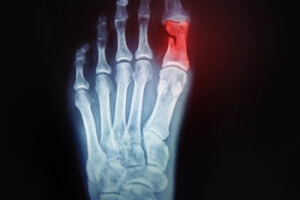
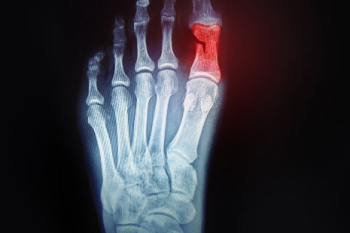
Broken toe injuries can result from various causes, including direct trauma, stubbing, or heavy objects falling on the foot. These injuries often occur during sports, accidents, or simple everyday activities. There are several types of broken toe injuries, each with distinct characteristics. Simple fractures involve a single break and usually heal without complications. Comminuted fractures, where the bone shatters into multiple pieces, are more complex and may require surgical intervention. Stress fractures, often caused by repetitive impact, present as small cracks in the bone. Displaced fractures occur when bone fragments shift out of alignment, potentially necessitating realignment. Identifying the fracture type is important for appropriate treatment and recovery. If you have broken your toe, it is suggested that you contact a chiropodist who can provide the correct treatment.
A broken toe typically occurs following either a sudden, traumatic injury, like dropping a heavy piece of furniture on the toe. The impact causes the bone to fracture and produces a variety of painful symptoms. If you suspect that you’ve broken your toe, please consult with Cynthia Chan, B.Sc., D.Ch from Healthy Advantage Foot & Orthotic Clinic. Our practitioner can help you maintain the health of your lower limbs and your mobility.
Symptoms
-
Throbbing pain
-
Swelling
-
Bruising
-
Cracking sound at the time of injury
-
Difficulty bearing weight on the toe
-
Difficulty walking
-
Toe resting at an unnatural angle
Diagnosis
Your chiropodist can diagnose a broken toe through physical examination and imaging studies, such as X-rays.
Treatment
The main goals of treatment are to ensure that the bone heals properly, as a toe fracture that doesn’t heal properly can lead to osteoarthritis. You will typically need to rest the affected toe. You may be prescribed a splint to immobilize the toe while it heals. Icing the affected toe and taking over-the-counter medications can help reduce pain. In cases of severe fractures, surgery may be necessary to reset the broken bones and make sure that they heal correctly.
If you have any questions, please feel free to contact our office located in . We offer the newest diagnostic and treatment technologies for all your foot care needs.
Broken Toe
Broken toes are a serious injury that requires prompt medical care. A toe bone can fracture following a sudden, traumatic injury, such as dropping a piece of furniture on the toe or stubbing it. If a toe bone has broken, you may hear a cracking sound at the time of injury. Shortly afterward, you will likely experience throbbing pain, swelling, bruising, and difficulty walking or bearing weight on the affected toe. In more severe cases, the broken bone may be displaced and resting at an odd angle, or it may be poking through the skin. A severe injury requires immediate medical care.
A chiropodist can diagnose a toe fracture by taking your medical history, examining the toe, and taking an X-ray. The right treatment for you will depend on the severity of the injury. Less severe fractures are usually treated conservatively. You will likely be asked to rest the affected foot. The chiropodist may buddy tape your broken toe to the toe right next to it in order to keep the broken toe in the right position for healing. Icing the affected toe and taking non-steroidal anti-inflammatory medication can help reduce pain. In more severe cases, surgery may be necessary to reset the bones. Sometimes, medical hardware like pins or screws is needed to help the toe heal properly.
Proper healing is very important, as a broken toe that does not fully heal or that doesn’t heal correctly can cause osteoarthritis later on in life. Your toe will likely be tender and swollen for several weeks following the injury. You will typically need to rest the toe for one to two months before resuming your usual activities. If you suspect that you may have broken your toe, please schedule an appointment with a chiropodist near you.