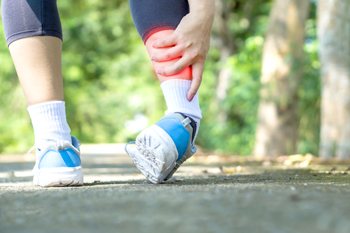
Three injuries most common among runners are Achilles tendonitis, heel bursitis, and sprained ankles. The first two heel and ankle injuries are considered to be caused by overuse and generally become worse over time. A sprain, however, is usually caused by trauma and is felt immediately. Achilles tendonitis affects the long tendon that connects the leg muscles to the calcaneus bone of the heel. If a runner increases the speed, distance, or duration of a run too quickly, the Achilles tendon can become irritated or inflamed. The injury may also be the result of calf muscles that are too tight and need to be stretched. Heel bursitis occurs when the small fluid sac, or bursa, that cushions the heel bone becomes inflamed by too much running, jumping, or walking. Because the same area is affected, heel bursitis can be confused with Achilles tendonitis. Ankle sprains occur when the ligaments that hold the ankle joint together are torn or stretched. Sprains commonly result from landing incorrectly on the foot, which rolls outward and pulls on the ligaments. If you have sustained any of these injuries, please consult a chiropodist for an exam, diagnosis, and appropriate treatment options.
Although running is a wonderful exercise to keep you in shape, it can wreak havoc on your feet and ankles if you don’t take preventive measures. If you have sustained a foot and ankle injury from running, please consult with Cynthia Chan, B.Sc., D.Ch from Healthy Advantage Foot & Orthotic Clinic. Our practitioner can help you maintain the health of your lower limbs and your mobility.
Some common running injuries include:
- Achilles tendonitis
- Shin splints
- Ankle sprains
- Stress fractures
- Plantar fasciitis
- Bursitis
What causes injuries?
These injuries are usually caused by overtraining, wearing the wrong shoes, running on hard surfaces, having tight and inflexible muscles, or having biomechanical issues in the feet or ankles.
What can I do to prevent injuries?
- Train slowly and gradually
- Give yourself plenty of time to recover following a run
- Wear shoes that fit properly and support your foot
- Avoid running on hard surfaces, like concrete
- Stretch and strengthen the muscles of your lower legs
- Warm-up prior to a run
- Have your gait analyzed and your feet examined by a chiropodist to determine if there are any biomechanical problems that need to be treated
If you have any questions please feel free to contact our office located in Scarborough, ON .